Open Ticket
  +373 79 600002
  Telegram Live Chat
  F.A.Q
F.A.Q  English
 Русский
  Română
  Deutsch
  Français
  Türkçe
  Español
  Português
  Українська
  български
  Polski
  Indonesia
  中文 (中国)






































































































































 on All Hosting Services



How to Access Your AlexHost Shared Hosting Control Panel (cPanel / LiteSpeed)
When you purchase a shared hosting plan from AlexHost — including LiteSpeed-optimized hosting — access to your control panel is provisioned instantly upon service activation. You reach it either through your AlexHost client dashboard or directly via the server's hostname on port 2083 using your cPanel credentials. No additional software is required; a modern browser is sufficient.
This guide covers both access methods in full technical detail, explains the dashboard features available after login, and addresses common authentication issues experienced administrators encounter in production environments.
Understanding the Hosting Control Panel Architecture
AlexHost's shared hosting infrastructure runs cPanel/WHM as the account management layer, with LiteSpeed Web Server (LSWS) replacing Apache as the underlying HTTP engine. This distinction matters operationally:
- cPanel handles user-facing configuration: DNS zones, email accounts, databases, file management, SSL provisioning, and cron jobs.
- LiteSpeed Web Server handles actual HTTP request processing, delivering significantly higher throughput and built-in cache (LSCache) compared to a standard Apache stack.
- Port 2083 is the standard HTTPS port for cPanel's user interface. Port 2082 is the unencrypted equivalent — always use 2083 in production.
When you log in via either method described below, you are authenticating against the cPanel layer. LiteSpeed operates transparently in the background and is configurable through cPanel's LiteSpeed Web Cache Manager plugin.
Method 1: Accessing the Control Panel Through the AlexHost Client Dashboard
This is the recommended method for first-time access because it eliminates the need to manually locate your server hostname or remember your initial credentials.
Step 1: Log In to Your AlexHost Client Account
Navigate to the AlexHost client portal and authenticate with your registered email address and account password. These credentials are separate from your cPanel/hosting credentials — conflating the two is one of the most common sources of access confusion.
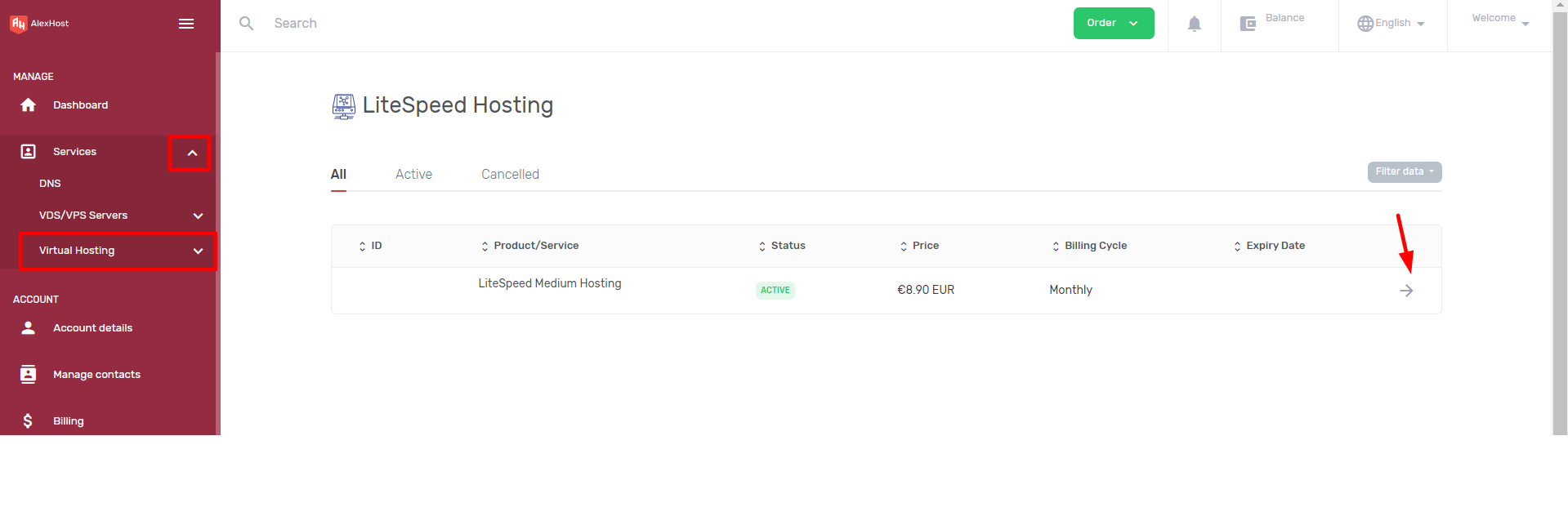
Step 2: Locate Your Active Hosting Service
Once inside the dashboard, navigate to Services or My Products & Services. All active subscriptions are listed here, including your Shared Web Hosting plan. Click on the relevant service to open its management panel.
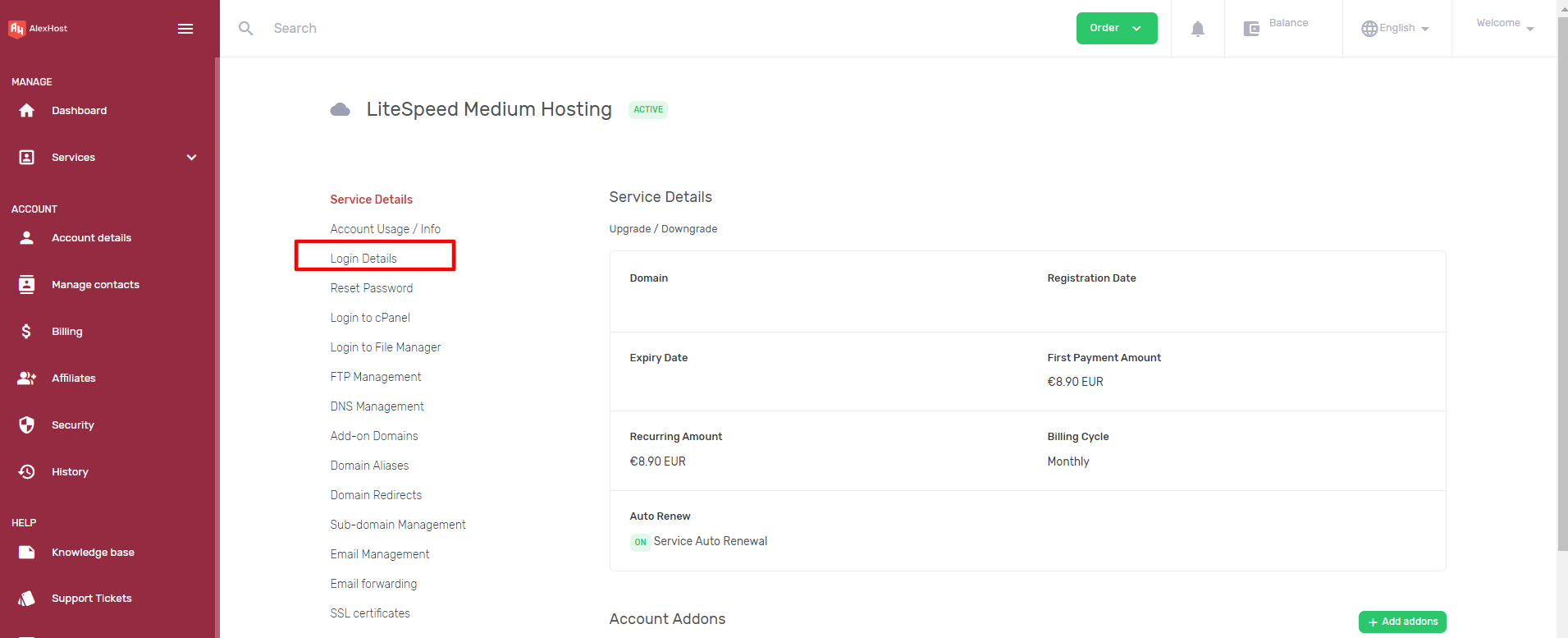
Step 3: Review the Service Management Panel
The service detail page exposes a consolidated set of management actions. Key options include:
- Account Usage / Info — displays disk quota consumption, inode count, bandwidth utilization, and the PHP version assigned to your account.
- Reset Password — generates a new cPanel password and emails it to your registered address. Use this if you have lost your hosting credentials.
- Login to cPanel — a single-click authenticated redirect that logs you directly into cPanel without requiring you to enter your username and password manually. This uses a session token issued by WHM.
- Login to File Manager — bypasses the cPanel home screen and drops you directly into the File Manager interface, useful for rapid file operations.
- FTP Management — displays existing FTP accounts, allows creation of new accounts with directory-scoped permissions, and shows the FTP hostname and port (21 for plain FTP, 990 for implicit FTPS).
Step 4: Retrieve Your Login Details
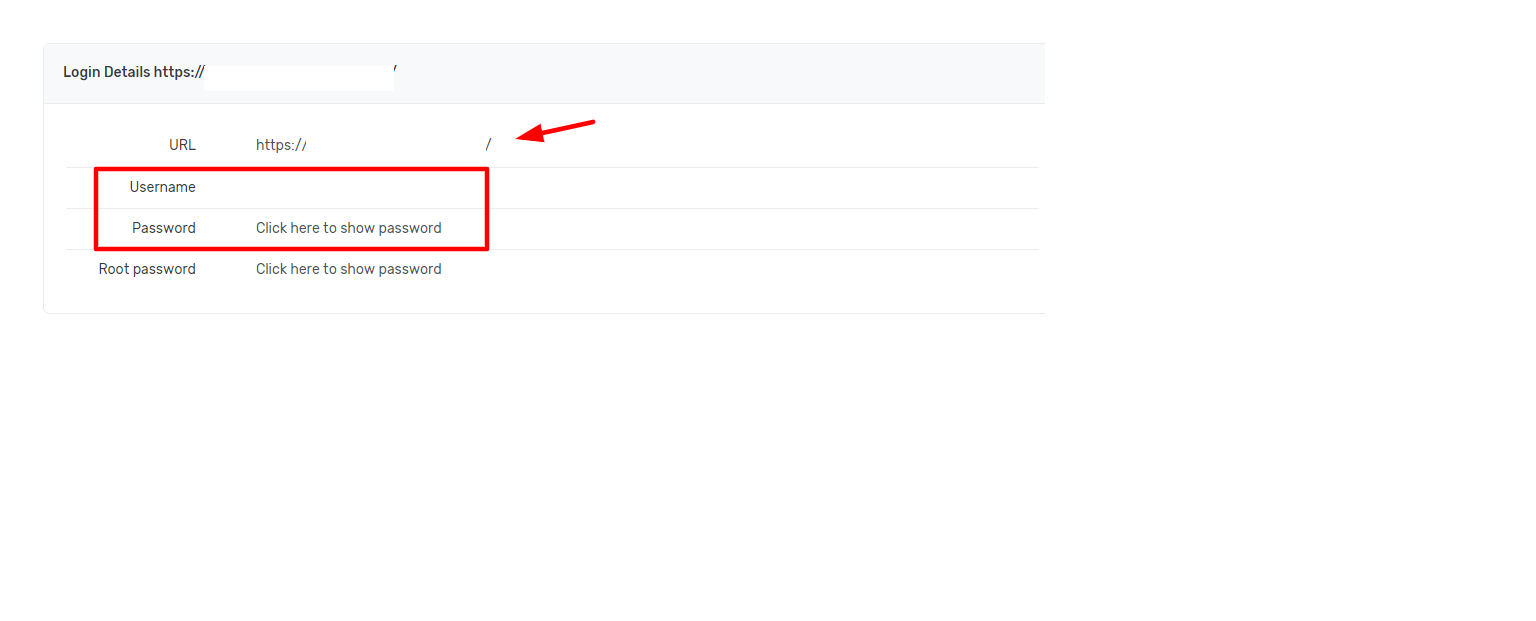
Select the Login Details option within the service panel. This screen displays:
- The direct cPanel URL for your specific hosting node (e.g.,
https://lshost3.alexhost.com:2083/) - Your cPanel username
- Your cPanel password (or a prompt to reset it if it has been hashed and is no longer retrievable in plaintext)
Record these credentials securely. A password manager is strongly recommended over storing credentials in plaintext files on the same server.
Method 2: Direct Browser Access to the cPanel Login Page
For experienced administrators who already have their credentials, direct URL access is faster and bypasses the client portal entirely. AlexHost operates multiple hosting nodes; use the URL that corresponds to the specific server your account resides on.
| Hosting Node | Direct cPanel URL |
|---|---|
| hosting2 | https://hosting2.alexhost.md:2083/ |
| lshost3 | https://lshost3.alexhost.com:2083/ |
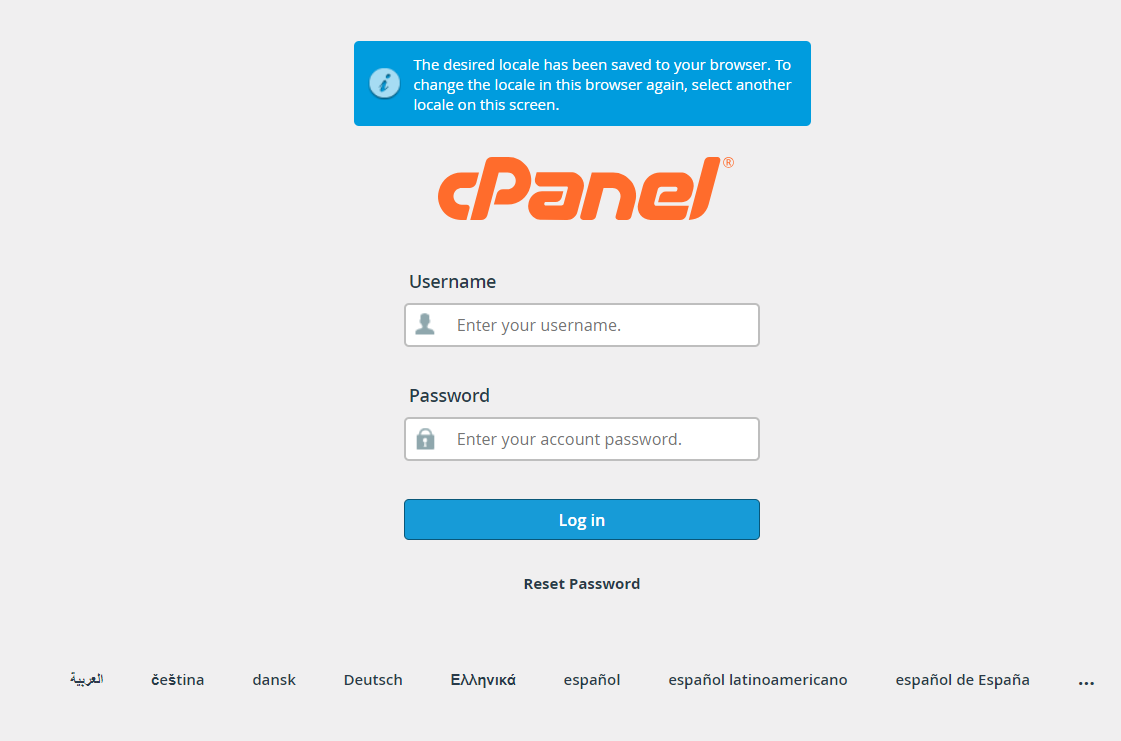
Type the appropriate URL into your browser's address bar. You will be presented with the standard cPanel login screen. Enter your cPanel username and cPanel password (not your AlexHost client portal credentials) and click Log In.
Critical note on SSL certificates: Both URLs serve cPanel over HTTPS. If your browser displays a certificate warning on first access, this typically means the server is using a hostname-bound certificate that does not match the URL you typed, or the certificate chain is incomplete. You can safely proceed past this warning for the initial login to retrieve your credentials — but for ongoing administrative access, configure a trusted SSL certificate on your domain and access cPanel via https://yourdomain.com:2083/. AlexHost provides SSL Certificates that can be installed directly through cPanel's SSL/TLS module.
Navigating the cPanel Interface After Login
Once authenticated, the cPanel home screen is organized into functional sections. Below is a breakdown of the areas most relevant to initial setup and ongoing administration.
Files
- File Manager — a full browser-based file browser with upload, extraction (ZIP/tar.gz), permissions editor, and code editor. Functionally equivalent to basic SFTP access.
- FTP Accounts — manage FTP users with per-directory chroot jails.
- Disk Usage — visual breakdown of disk consumption by directory, critical for identifying runaway log files or oversized upload directories.
- Backup / Backup Wizard — generates full or partial account backups downloadable as
.tar.gzarchives.
Databases
- MySQL Databases — create databases, assign users, and set granular privileges.
- phpMyAdmin — browser-based MySQL administration. Supports import/export of
.sqldumps up to theupload_max_filesizelimit configured in PHP. - Remote MySQL — whitelist external IP addresses permitted to connect to your MySQL instance on port 3306. Essential for applications with a separate application server.
Domains
- Addon Domains — host additional domains under the same cPanel account, each with its own document root.
- Subdomains — create subdomains pointing to subdirectories or external IP addresses via CNAME.
- Redirects — configure 301 or 302 redirects at the server level without modifying
.htaccess. - Zone Editor — manage DNS A, CNAME, MX, TXT, and SRV records directly. Relevant if AlexHost's nameservers are authoritative for your domain. You can register and manage your domain through Domain Registration.
- Email Accounts — create mailboxes with configurable storage quotas.
- Forwarders — route incoming mail to external addresses without storing a local copy.
- MX Entry — override the default MX record if you use a third-party mail provider (e.g., Google Workspace, Microsoft 365).
- SpamAssassin — server-side spam filtering with configurable score thresholds.
For businesses requiring dedicated mail infrastructure with higher deliverability guarantees, Email Hosting provides isolated mail server resources separate from the shared web hosting environment.
Software / PHP Configuration
- MultiPHP Manager — assign different PHP versions (7.4, 8.0, 8.1, 8.2, 8.3) per domain without affecting other accounts on the server.
- MultiPHP INI Editor — override
php.inidirectives at the account level:memory_limit,max_execution_time,upload_max_filesize,post_max_size, anddisable_functions. - Softaculous Apps Installer — one-click deployment of WordPress, Joomla, Drupal, Magento, and 400+ other applications with automated database provisioning.
LiteSpeed Cache Manager
This plugin, exclusive to LiteSpeed-powered hosting nodes, exposes:
- LSCache enable/disable toggle per domain
- Purge Cache controls (full purge or URL-specific)
- Cache exclusion rules based on URI patterns or cookies
LSCache dramatically reduces Time to First Byte (TTFB) for WordPress and other CMS-driven sites by serving pre-rendered HTML from memory rather than executing PHP on every request.
Comparison: Client Dashboard Access vs. Direct URL Access
| Criteria | Client Dashboard (Method 1) | Direct URL (Method 2) |
|---|---|---|
| Requires client portal login | Yes | No |
| Credential retrieval | Available in "Login Details" | Must already know credentials |
| Speed of access | Slower (two-step) | Faster (single URL) |
| Session token (no password entry) | Yes, via "Login to cPanel" button | No, manual credential entry |
| Best for | First-time setup, password recovery | Daily administration |
| Works without knowing server hostname | Yes | No |
Common Access Issues and Technical Resolutions
"This site can't be reached" on Port 2083
Port 2083 may be blocked by a corporate firewall or ISP-level packet filter. Verify connectivity with:
curl -v https://lshost3.alexhost.com:2083/ --max-time 10If the connection times out rather than returning an HTTP response, the block is network-level. Solutions: use a VPN, switch to a mobile data connection for testing, or contact your network administrator to whitelist the port.
SSL Certificate Warning on Direct Access
As noted above, this occurs when the server's SSL certificate is issued to a different hostname than the one in your URL. This is expected behavior on shared hosting nodes where the server certificate is bound to the node's hostname, not your domain. It does not indicate a security compromise for initial access — but you should install a domain-specific certificate for production use.
Incorrect Password / Authentication Failure
The two most common causes:
- Credential confusion — entering client portal credentials on the cPanel login screen. These are distinct credential sets.
- Password reset not propagated — after using the "Reset Password" function in the client dashboard, allow 30–60 seconds for the change to replicate to the authentication backend before attempting login.
cPanel Session Timeout
cPanel sessions expire after a configurable idle period (default: 60 minutes). If you are performing long-running operations (large file uploads, database imports), use SFTP or the command line rather than browser-based tools to avoid session interruption.
When to Upgrade Beyond Shared Hosting
Shared hosting with cPanel is appropriate for low-to-medium traffic websites, development environments, and small business web presences. You should evaluate migration when:
- CPU throttling becomes visible in cPanel's Resource Usage reports
- PHP memory limits cannot be raised sufficiently within shared hosting constraints
- Dedicated IP address is required for certain SSL configurations or email reputation management
- Custom server software (Node.js daemons, custom compiled modules, non-standard PHP extensions) is needed
At that point, a VPS Hosting plan provides root access, dedicated resources, and full control over the software stack — including the option to install cPanel/WHM via VPS with cPanel for a familiar management interface with significantly more headroom.
Technical Decision Checklist
Use this checklist before and after your first login to ensure your hosting environment is correctly configured:
- Confirm you are using cPanel credentials, not client portal credentials, on the direct login URL
- Verify your hosting node URL matches the server your account is provisioned on (
hosting2.alexhost.mdvs.lshost3.alexhost.com) - Install a domain-specific SSL certificate via cPanel's SSL/TLS module to eliminate browser warnings
- Set your PHP version via MultiPHP Manager to match your application's requirements
- Enable LSCache in the LiteSpeed Cache Manager for any CMS-based site
- Configure Remote MySQL access if your application connects from an external server
- Create a dedicated FTP account with a scoped document root rather than using the primary cPanel credentials for FTP
- Schedule a cPanel backup or configure an automated backup solution before making significant configuration changes
- Whitelist your IP in Remote MySQL if you use a local database client (e.g., TablePlus, DBeaver, MySQL Workbench)
- Review disk and inode usage in cPanel's Disk Usage tool — inode exhaustion is a frequent cause of silent failures on shared hosting
FAQ
What is the difference between my AlexHost account password and my cPanel password?
Your AlexHost client account password authenticates you to the billing and service management portal. Your cPanel password is a separate credential that authenticates you to the web hosting control panel on the server. They are independent and can differ. Resetting one does not affect the other.
Which port does cPanel use, and why does it need to be open?
cPanel's SSL-secured interface runs on TCP port 2083. This port must be reachable from your IP address through any intermediate firewalls. Port 2082 is the unencrypted alternative but should not be used in production. If port 2083 is blocked, use the client portal's "Login to cPanel" button, which generates an authenticated redirect and may bypass direct port access requirements.
Can I access cPanel on a mobile device?
Yes. cPanel's interface is responsive and functional on mobile browsers. However, the File Manager and Zone Editor are significantly easier to use on a desktop. For mobile-only administration tasks, the cPanel mobile app (available for iOS and Android) provides a streamlined interface for common operations.
What does the LiteSpeed Cache Manager do, and should I always enable it?
LSCache is a server-level full-page cache that stores rendered HTML output and serves it directly from memory, bypassing PHP execution entirely for cached requests. It should be enabled for all CMS-driven sites (WordPress, Joomla, Drupal). For purely dynamic applications where every response is user-specific (e.g., SaaS dashboards, e-commerce checkouts), configure cache exclusion rules rather than disabling LSCache entirely, as static assets can still benefit from caching.
How do I find out which hosting node my account is on?
Log in to the AlexHost client portal, navigate to your active hosting service, and select "Login Details." The direct cPanel URL displayed there contains the server hostname (e.g., lshost3.alexhost.com or hosting2.alexhost.md). This is the hostname you should use for direct browser access, SFTP connections, and FTP configuration.