Ticket öffnen
  +373 79 600002
  Telegramm Live Chat
  Häufige Fragen
  Deutsch
 English
  Русский
  Română
  Français
  Türkçe
  Español
  Português
  Українська
  български
  Polski
  Indonesia
  中文 (中国)






































































































































 bei allen Hosting-Diensten






So fügen Sie zusätzliche Domains zu Ihrem Hosting-Konto in cPanel hinzu
Adding additional domains to your hosting account in cPanel takes under two minutes: log in to cPanel, navigate to Domains > Create a New Domain, enter the domain name, uncheck the shared document root option to generate an isolated directory, and click Submit. The domain becomes active immediately within the hosting environment, though public DNS propagation can take up to 48 hours depending on your registrar and TTL settings.
This guide covers the complete process for AlexHost Shared Web Hosting accounts running cPanel, including the technical implications of document root isolation, subdomain vs. addon domain behavior, DNS zone creation, and common configuration pitfalls that even experienced administrators encounter.
What "Additional Domains" Actually Means in cPanel
Before touching the interface, it is worth understanding what cPanel does under the hood when you add a domain. The term has evolved across cPanel versions, and conflating it with older terminology causes real configuration errors.
In cPanel versions prior to 76, the interface distinguished between three domain types:
- Addon Domains — fully independent domains mapped to a subdirectory of the primary account, with their own document root, DNS zone, and FTP credentials.
- Parked Domains (Aliases) — domains that mirror the primary domain's content with no separate document root.
- Subdomains — hostname extensions of an existing domain (e.g.,
blog.yourdomain.com) pointing to a subdirectory.
From cPanel version 76 onward, WHM/cPanel consolidated addon domains and aliases into a unified Domains interface. When you use "Create a New Domain" today, you are creating what was previously called an addon domain — a fully hosted domain with its own web root, DNS zone file, and independent configuration. This is the correct option for hosting a separate website under the same account.
Prerequisites Before Adding a Domain
Skipping these checks is the most common reason domain additions fail or produce unexpected behavior.
1. Verify your plan's domain limit
AlexHost hosting plans enforce a hard cap on the number of hosted domains. Exceeding this limit will silently prevent the new domain from being created. Log in to your client area and confirm how many additional domains your current plan supports before proceeding.
2. Confirm domain registration and nameserver delegation
The domain you intend to add must already be registered. If you have not yet registered it, you can do so through Domain Registration before proceeding. More critically, the domain's nameservers must be pointed to AlexHost's nameservers so that cPanel can manage the DNS zone. If nameservers are still delegated to your registrar or a third-party DNS provider, cPanel will create the hosting configuration but DNS resolution will not work until the delegation is corrected.
3. Check for existing DNS zone conflicts
If the domain was previously hosted on the same server or another account on the same WHM instance, a residual DNS zone may exist. Adding the domain without removing the orphaned zone will cause cPanel to throw an error or, worse, silently map the domain to the wrong document root.
Step-by-Step: Adding a Domain in cPanel
Step 1 — Access Your cPanel Dashboard
Log in to your AlexHost client area and navigate to your hosting account's cPanel. The direct URL is typically yourdomain.com:2083 or yourdomain.com/cpanel. Authenticate with your cPanel credentials (distinct from your client area credentials unless you have configured SSO).
Step 2 — Open the Domains Section
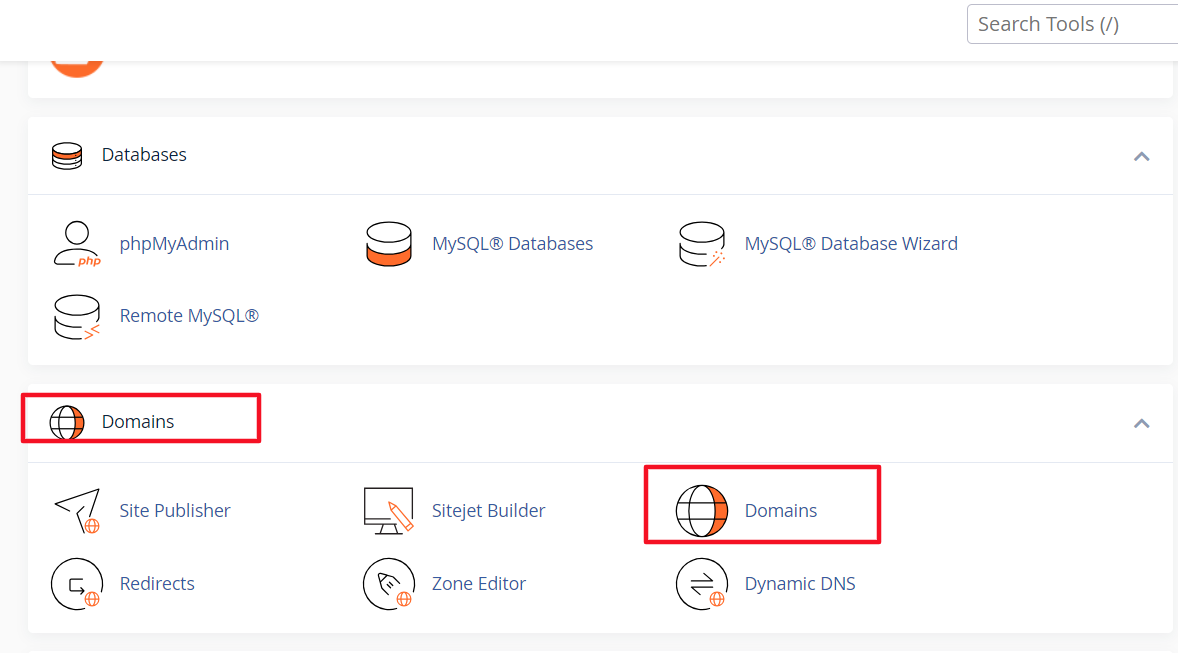
From the cPanel home screen, locate the Domains section. In modern cPanel themes (Paper Lantern and Jupiter), this appears as a prominent card in the main dashboard. Click Domains to open the domain management interface, which lists all currently hosted domains on your account.
Step 3 — Click "Create a New Domain"
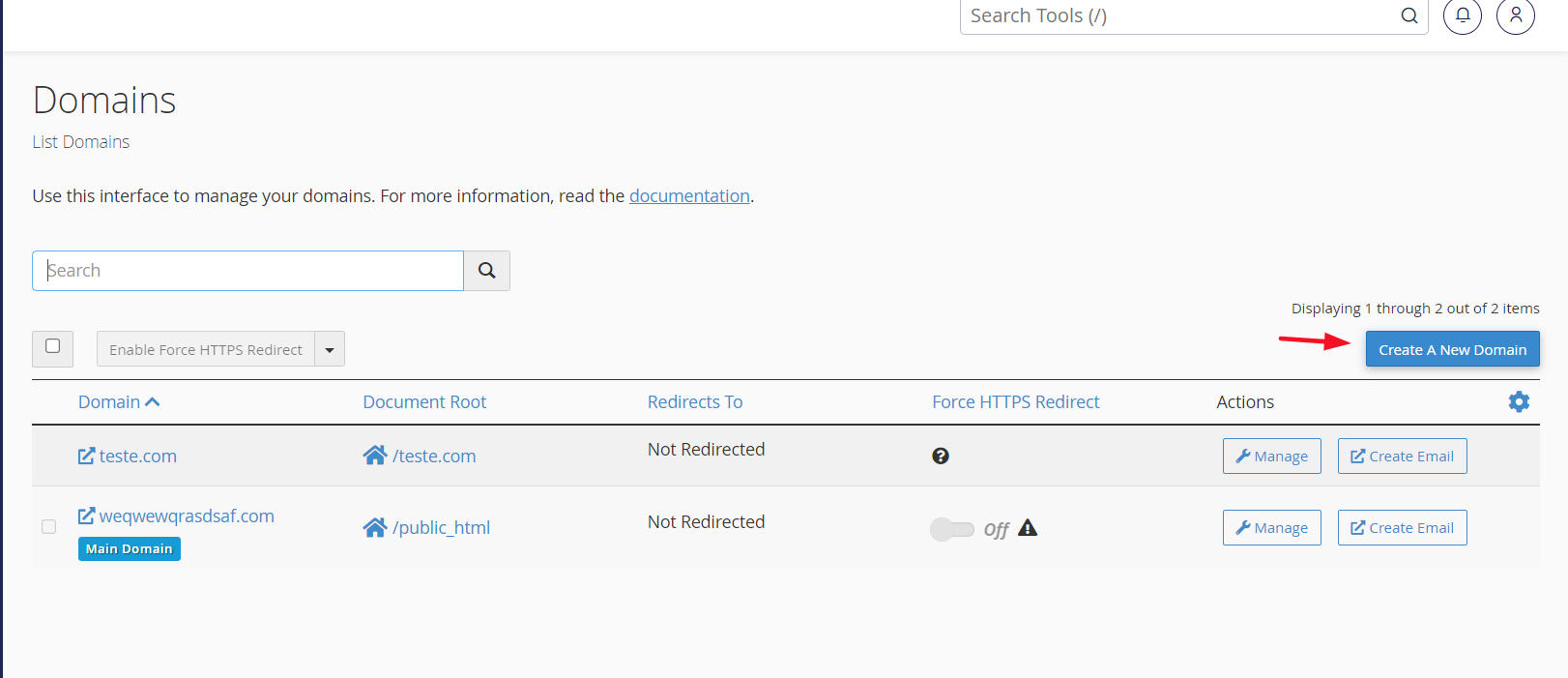
Inside the Domains manager, click the Create a New Domain button. This opens the domain creation form.
Step 4 — Enter the Domain Name
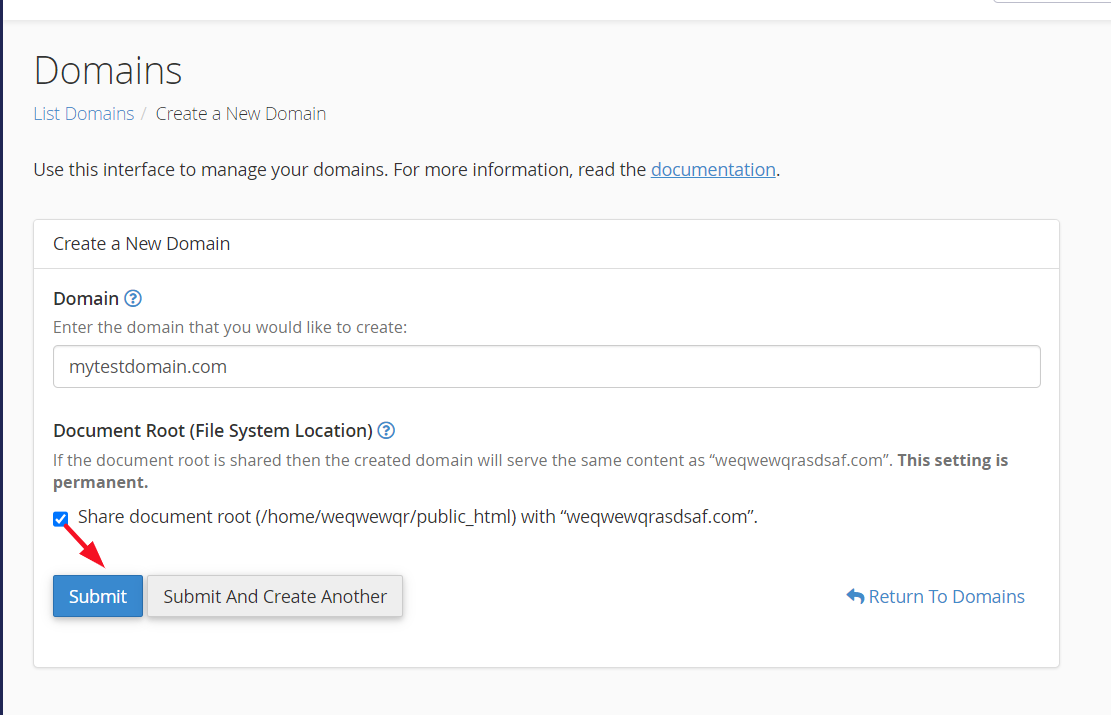
In the Domain field, type the fully qualified domain name you want to add — for example, newsite.com. Do not include http://, www., or trailing slashes. cPanel will automatically handle the www subdomain as an alias.
Step 5 — Configure the Document Root (Critical Step)
This is where most users make a consequential mistake.
By default, cPanel pre-populates the Document Root field with a path like public_html/newsite.com. It also presents a checkbox labeled "Share document root" or a similar option that, if left checked, maps the new domain to the same public_html directory as your primary domain.
You must uncheck this option if you want the new domain to have its own isolated web root. Leaving it checked means both domains serve identical content from the same directory — which is occasionally intentional (domain mirroring) but almost never what you want for a separate website.
With the checkbox unchecked, cPanel creates:
- A new directory at
public_html/newsite.com/(or your specified path) - An independent DNS zone for
newsite.com - A separate
wwwsubdomain record pointing to the same root
Step 6 — Submit and Verify
Click Submit. cPanel will display a success confirmation. The domain is now active at the server level. You can immediately upload files to its document root via FTP, SFTP, or the File Manager.
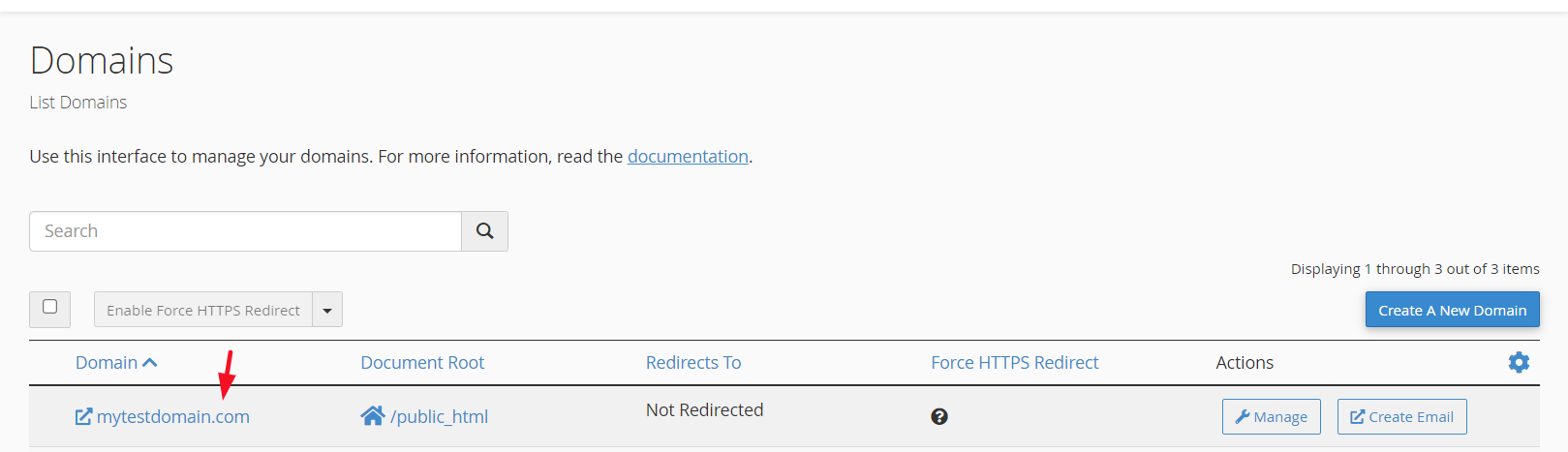
To verify the configuration, return to the Domains list — your new domain should appear with its document root path displayed. You can also check the DNS zone by navigating to cPanel > Zone Editor and confirming that A records, CNAME records for www, and MX records (if applicable) have been created correctly.
Document Root Isolation vs. Shared Root: A Technical Comparison
| Configuration | Document Root | DNS Zone | Use Case | Risk |
|---|---|---|---|---|
| Isolated root (unchecked) | public_html/newsite.com/ | Separate zone created | Independent website | None for standard use |
| Shared root (checked) | public_html/ | Separate zone created | Domain alias / mirror | Both domains serve identical content |
| Subdomain | public_html/sub/ | Record added to parent zone | Section of existing site | Inherits parent domain's zone |
| Parked/Alias domain | Same as primary | Points to primary zone | Brand protection, redirects | No independent content possible |
DNS Propagation: What Happens After You Click Submit
Server-side configuration is instantaneous. DNS propagation is not.
When cPanel creates the DNS zone, it writes the zone file to the nameserver immediately. If your domain's nameservers are already pointed to AlexHost, the zone is authoritative and resolves correctly within minutes for most users. However, recursive resolvers worldwide cache DNS records based on the TTL (Time to Live) value of the previous records. If your domain previously pointed elsewhere with a high TTL (e.g., 86400 seconds / 24 hours), some users may continue reaching the old server for up to that TTL period.
Practical mitigation: Before migrating a live domain, lower the TTL on all existing DNS records to 300 seconds (5 minutes) at least 24 hours in advance. This minimizes the propagation window during the actual cutover.
For new domains with no prior DNS history, propagation is typically complete within 15–30 minutes globally.
SSL Certificates for Additional Domains
Every domain you add should be secured with HTTPS. AlexHost's cPanel environment supports AutoSSL, which automatically provisions and renews free Let's Encrypt certificates for all hosted domains. After adding your domain, navigate to cPanel > SSL/TLS Status and trigger an AutoSSL run if the certificate has not been issued automatically within a few minutes.
For domains requiring extended validation, wildcard coverage, or organization validation — particularly for e-commerce or enterprise use — consider a dedicated SSL Certificate rather than relying solely on the domain-validated AutoSSL certificate.
One important edge case: AutoSSL will fail to issue a certificate if the domain's DNS is not yet resolving to the server's IP address. If you add a domain before completing nameserver delegation, AutoSSL will log a failure. Re-trigger it after DNS propagation completes.
Email Hosting for Additional Domains
Once a domain is added to cPanel, you can immediately create email accounts under it via cPanel > Email Accounts. The MX records are automatically populated in the DNS zone during domain creation, pointing to the server's mail handler.
If you require professional email infrastructure separate from your web hosting — for example, routing mail through a dedicated mail server with higher deliverability guarantees — review Email Hosting options that provide isolated mail environments with SPF, DKIM, and DMARC pre-configured.
Scaling Beyond Shared Hosting: When to Upgrade
Shared hosting plans have a fixed ceiling on the number of addon domains, inodes, and concurrent connections. If you are managing more than 5–10 active domains with meaningful traffic, you will encounter resource contention — particularly around PHP-FPM worker limits and MySQL connection pools.
At that threshold, migrating to a VPS Hosting environment gives you full root access, the ability to configure per-domain PHP versions independently, and no artificial cap on hosted domains. For teams that prefer a managed interface without sacrificing flexibility, a VPS with cPanel replicates the familiar workflow at a significantly higher resource ceiling.
High-traffic domains with database-intensive workloads — particularly WooCommerce stores or SaaS applications — benefit from Dedicated Servers where CPU, RAM, and storage I/O are not shared with any other tenant.
Common Errors and How to Resolve Them
"Domain already exists on this server"
A DNS zone for this domain exists in WHM from a previous account or a failed deletion. The server administrator must remove the orphaned zone from WHM > DNS Zone Manager before the domain can be re-added.
"You have reached the maximum number of domains"
Your current plan's domain limit is exhausted. Either remove an unused domain from the account or upgrade your hosting plan.
AutoSSL certificate not issuing
DNS is not yet resolving to the correct server IP. Verify nameserver delegation, wait for propagation, then manually trigger AutoSSL from cPanel > SSL/TLS Status.
Files uploaded but domain shows the primary site's content
The shared document root checkbox was left enabled during domain creation. Delete and re-add the domain with the isolated root option, or manually update the domain's document root path in cPanel > Domains.
www subdomain not resolving but bare domain works
The CNAME record for www was not created or was deleted. Navigate to cPanel > Zone Editor, select the domain, and add a CNAME record: www pointing to @ (or the bare domain).
Technical Checklist: Adding a Domain Correctly
Use this checklist for every domain addition to avoid the errors described above:
- [ ] Confirm the hosting plan's domain limit has not been reached
- [ ] Register the domain or verify it is already registered
- [ ] Point the domain's nameservers to AlexHost nameservers before adding in cPanel
- [ ] If migrating a live domain, reduce TTL to 300 seconds at least 24 hours in advance
- [ ] In cPanel > Create a New Domain, uncheck the shared document root option
- [ ] Verify the document root path is unique and not overlapping with another domain
- [ ] Confirm the domain appears in cPanel > Domains list with correct root path
- [ ] Check cPanel > Zone Editor to verify A, CNAME (www), and MX records exist
- [ ] Wait for DNS propagation, then verify AutoSSL has issued a valid certificate
- [ ] Test the domain over HTTPS from an external network or using a tool like
digornslookup - [ ] Create email accounts under the new domain if required
FAQ
Can I add a domain to cPanel before its DNS is propagated?
Yes. cPanel creates the server-side configuration immediately regardless of DNS status. You can upload files and test the site using a hosts file entry on your local machine while DNS propagates publicly.
What is the difference between an addon domain and a subdomain in cPanel?
An addon domain is a fully independent domain with its own document root and DNS zone, capable of hosting a completely separate website. A subdomain is a hostname extension of an existing domain (e.g., shop.yourdomain.com) and shares the parent domain's DNS zone.
Will adding multiple domains slow down my hosting account?
Adding domains itself has no performance impact. Performance degradation occurs when the sites hosted on those domains generate traffic that exceeds the plan's CPU, RAM, or I/O allocation. The domains themselves are just routing configurations.
How do I remove a domain I no longer need?
In cPanel > Domains, click the Manage link next to the domain, then select Remove Domain. This deletes the DNS zone and document root mapping but does not delete the files in the document root directory — you must remove those manually via File Manager or FTP if you want to reclaim disk space.
Can I host domains registered at different registrars on the same cPanel account?
Yes. cPanel does not require domains to be registered with any specific registrar. The only requirement is that each domain's nameservers are delegated to AlexHost's nameservers so that cPanel controls the DNS zone. Domains from any registrar work identically once nameserver delegation is complete.